


From a board level perspective, the case for migration is typically supported by several legitimate considerations:
- Future state enablement, including analytics, automation and AI readiness.
- Platform scalability and simplification aligned to long term growth.
- SAP ECC (ERP Central Component) maintenance timelines, which introduce long range support and cost considerations.
- Cybersecurity concerns, particularly following high-profile incidents.
- Technology leadership messaging that positions migration as a strategic milestone.
These drivers are valid and important. The opportunity for executives is to ensure that enthusiasm for the future state is balanced with disciplined planning around execution, risk and capital deployment.
Balanced risk framing
One of the most important governance responsibilities is ensuring balanced risk framing. Therefore, effective oversight is needed, including monitoring risks on both sides of the decision:

Successful organizations treat S/4HANA migration risk as probabilistic and comparative, not binary. While risk cannot be removed entirely, it can be evaluated, prioritized and governed deliberately Leveraging a risk heat map or transformation control tower has proven effective for our clients in the past.
Preserving financial customizations and controlling integrity through the transition
A critical area for CFOs and audit committees to monitor is the role of existing ECC customizations, particularly those embedded in financial and compliance processes.
Key considerations include:
- Identifying which customizations directly support revenue recognition, costing, inventory valuation and regulatory reporting.
- Assessing how those capabilities will be retired, replaced or implemented under a clean core model.
- Understanding where standard S/4HANA functionality fully meets requirements versus where extensions or redesign are necessary.
Standardization can reduce long term complexity, but it must be approached deliberately. Effective programs make intentional decisions about customization, retaining or redesigning based on clear financial impact and control implications. For a deeper look at how organizations make these customization decisions in practice, read Fit-to-Standard vs. Customization in SAP S/4HANA: How to Decide What’s Right.
Integrating, not substituting, security strategy
Cybersecurity is often cited as a major driver for S/4HANA migration. The opportunity for executive oversight is ensuring that security investments are aligned to actual risk drivers.
Key monitoring areas include:
- Whether historical incidents originated within ERP platforms or external systems.
- How identity, access, segmentation and monitoring controls will function during and after migration.
- Ensuring cybersecurity investments complement ERP modernization, rather than assuming migration alone mitigates risk.
Strong programs treat S/4HANA as one component of a broader cybersecurity and resilience strategy.
Independent validation and readiness assessment strengthens the decision
High performing organizations often introduce independent assessments as a formal checkpoint prior to approving large ERP investments.
These reviews typically focus on:
- Financial exposure and downside scenarios.
- Internal control and audit readiness.
- Realism of value realization assumptions.
- Organizational capacity for change.
- Capital allocation alternatives.
This step does not slow progress; it improves decision quality and strengthens executive confidence that the organization is proceeding on a sound foundation.
Preserving optionality while advancing readiness
Many organizations are adopting phased approaches that allow progress without full commitment. Key considerations for this approach include:
- Support strategy optimization to manage ECC cost and stability during transition planning.
- Targeted cybersecurity and compliance investments that deliver immediate risk reduction.
- Incremental S/4HANA readiness activities, including data cleanup, process harmonization and skills development.
This approach preserves capital flexibility while positioning the organization for a smoother migration when the timing is right.
Opportunity cost as a governance metric
For CFOs, one of the most important oversight questions is: “Is this the highest value use of capital at this point in time?”
- Monitoring opportunity cost involves:
- Comparing ERP investment returns against growth, innovation and operational investments.
- Understanding executive bandwidth and organizational capacity constraints.
- Assessing whether the timing of migration maximizes—not dilutes—enterprise value.
Organizations that explicitly include opportunity cost in ERP decision making tend to execute migrations with greater confidence and fewer surprises.
Key areas executives should monitor
The list below contains a summary of the key areas that executives need to monitor and manage throughout the migration process.
- Clear linkage between migration objectives and enterprise value.
- Balanced disclosure of migration and non‑migration risks.
- Financial control and audit readiness throughout the transition.
- Cybersecurity alignment across the full technology landscape.
- Capital efficiency and phased investment discipline.
- Independent validation before major funding decisions.
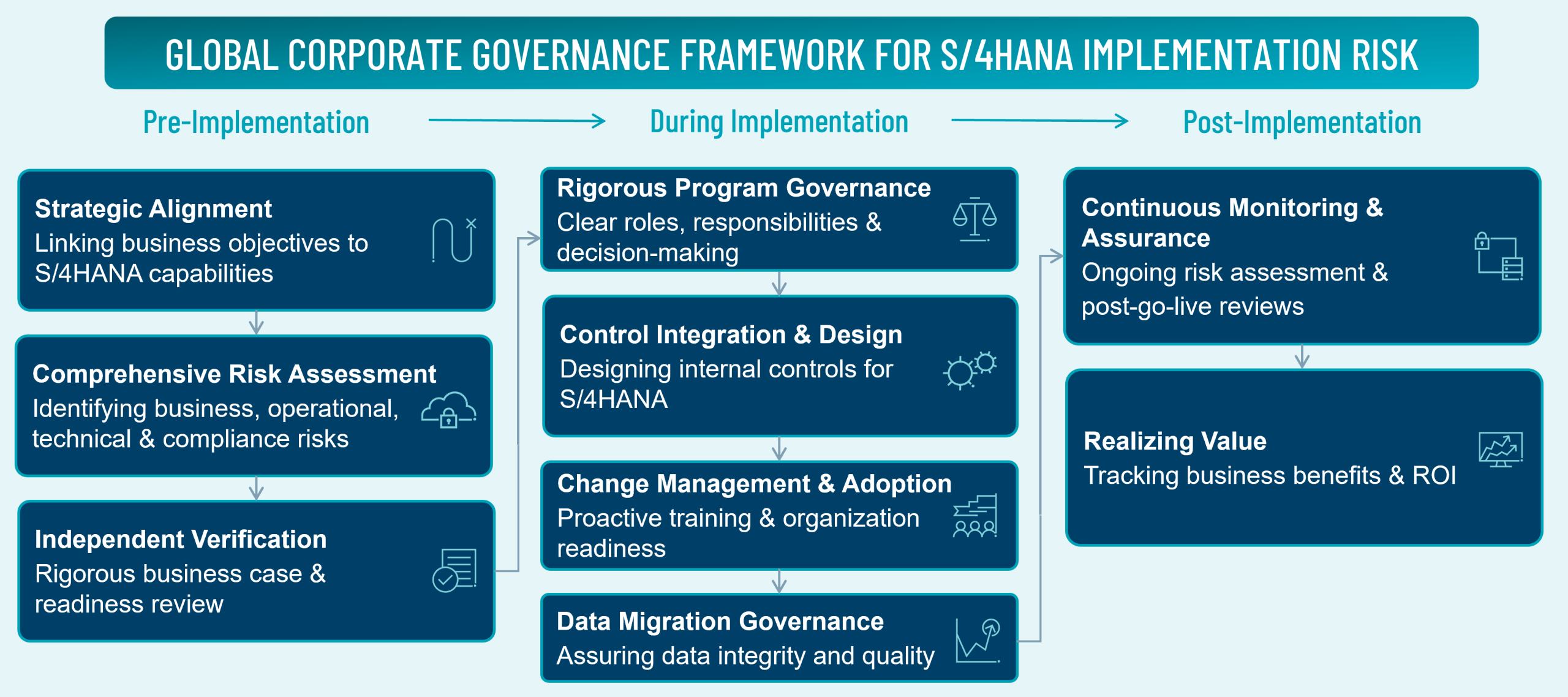
Most SAP ECC customers will migrate to S/4HANA over time. The defining question for executives is how to effectively govern the migration to reduce risk and improve the likelihood of success.
Organizations that succeed approach S/4HANA as a managed transformation grounded in financial discipline, risk awareness and thoughtful sequencing.
When these key areas are actively monitored, S/4HANA migration becomes a controlled, value-driven enterprise investment.
As a trusted SAP partner, Protiviti works with organizations to bring discipline, transparency and independent validation to complex S/4HANA transformation decisions.
To learn more about our SAP consulting services, contact us.