



As organizations move to Workday, where Accounts Payable (AP) lands at go-live often represents a moment of truth. Because AP sits downstream from nearly every finance and procurement process, it becomes a strong indicator of whether the transformation was executed effectively or whether underlying issues remain unresolved.
Too often, AP is treated as an afterthought during a Workday transformation despite driving critical components of the income statement, balance sheet and cash flow. When AP operations are executed well, they build trust and stability across the organization. When they are not, small problems ripple into bigger ones. Missed payments, supplier frustration, compliance concerns and teams stuck in constant catch-up mode become all too common.
A Workday implementation is the perfect time to reimagine AP functions from the ground up. Workday brings visibility, automation and control, but technology alone cannot solve everything. Real transformation happens when strong processes, clear ownership and well-trained people work together inside the system.
Challenges: the trouble before the change
Teams that have worked with AP long enough tend to see the same patterns repeat: invoices go missing, approvals take too long and duplicate payments slip through. Business impacts can include suppliers being forced to place the company on credit hold, staff spending their days reacting to problems instead of improving their processes and finance leaders left with unreliable data in areas where they need clear answers.
These issues drain energy and time. They erode confidence across the organization. And while new technology can help, it will also expose what is not working.

Success enablement: building team consensus
At the core of many AP challenges are manual workarounds, fragmented communication and unclear ownership. While procurement, receiving and AP each play a role, they often operate in silos.
Inconsistent vendor setup, limited training and job support and ad hoc exception handling further compound the issue. Without a shared view of the end-to-end process, consistent rules and defined ownership, operational breakdowns are inevitable.
Although Workday is not a magic wand that will fix gaps automatically, a comprehensive cross-functional design, proper configuration choices and thorough testing will reveal them. Strengthening the foundation before go-live gives AP teams a chance to use the system as it is meant to be used and leverage the leading practice behaviors inherent to the Workday platform. The more organized and consistent operations are before the transition, the more powerful Workday becomes afterward.
Solution design: building the foundation
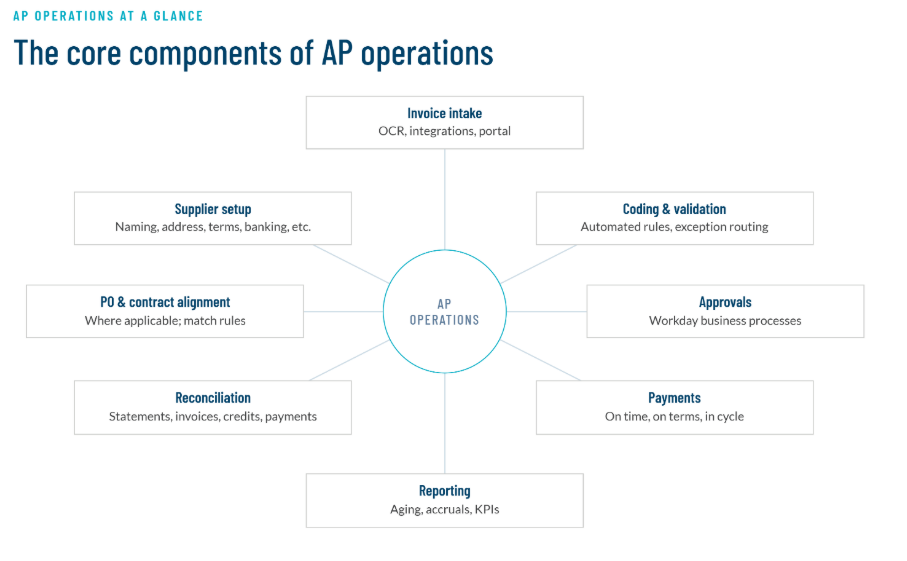
Clean supplier data, along with consistent PO and contract use, reduce most of the avoidable friction AP sees in Workday. These areas don’t need to be perfect, but they should be stable enough so that invoices can flow without constant exceptions. From there, invoice intake becomes the main driver of processing efficiency. Invoices may have varying points of entry, but ingestion and coding automation should be emphasized. Ultimately, every invoice which lands in Workday, whether captured via OCR technology, a custom invoice integration or an invoice processing intermediary, should be handled in a way that minimizes human intervention. A reduction in manual work leading to consistency in processing will help reduce errors that lead to late payments or disputes.
Invoice reconciliation should follow close behind. Comparing supplier statements with invoices captured in Workday will help identify missing items, outstanding credits and payments that have not yet been applied by suppliers. When those items are resolved before their due dates, operations run smoothly and supplier confidence grows.
With the basics in place, the focus can shift to structure and people. Define who owns each part of the process: intake, coding and validation, approvals and payments. Use Workday’s built-in business process rules, approval routing and reporting to create clarity and enforce accountability. Then invest in training so the AP team understands both the system and the reasoning behind it.
Finally, clear supplier communication is essential and reinforces the foundation. Setting expectations and maintaining regular touchpoints reduce confusion and build trust, minimizing the need for ad hoc outreach or manual follow-ups.
Turning AP into a strategic advantage
Workday provides powerful tools to enhance AP, but their effectiveness depends on a solid foundation. Strengthening intake, streamlining reconciliation and aligning people and processes help AP teams shift from reactive to proactive. When that happens, AP becomes a source of control, potential cost savings, insight and confidence that strengthens every part of the business.
Protiviti can help organizations looking to strengthen their AP foundations ahead of Workday to assess source-to-pay and identify practical improvements before go-live.
Austin Horton, Simone Stavros and Bob Kiddoo also contributed to this post.
To learn more about our Workday consulting services, contact us.