


Microsoft‘s Power Platform’s low code capabilities help organizations accelerate innovation, but broader access to applications, automation and data requires clear security controls. Effective governance provides the guardrails that enable innovation to scale safely and responsibly, an element detailed in Protiviti’s 2027 Executive Perspectives on Top Risks and Opportunities survey, where half of the top 10 near-term risks executives identified relate to protecting enterprise value, emphasizing that prioritizing factors including AI governance is central to enabling an organization’s transformation.
Security starts with five business questions
A practical Power Platform security model should answer five questions:
- Where can people work?
- Who are they?
- What can they do?
- What can they see?
- What is allowed?
These questions represent different layers of security. Addressing only one layer, such as user authentication, is not enough to protect business data. A person may be allowed to enter an environment, but that does not mean they should be able to view every record, change every column or share information outside the organization.
In an enterprise governance model, environment access merely opens the front door; security roles and teams dictate what users can touch once inside.
Think of security as a building
One way to make Power Platform security easier to understand is to compare it to a secure business campus: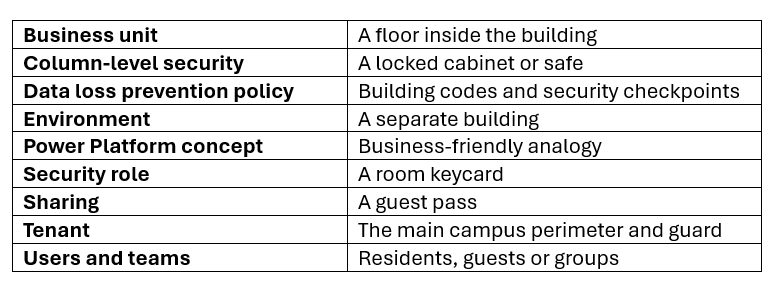
Each layer serves a different purpose.
An environment can separate development, testing and production activities. Business units can reflect departments, regions or other organizational boundaries. Roles and teams can determine what people are allowed to do. Column-level security can protect particularly sensitive information within an otherwise accessible record.
This layered approach helps organizations avoid treating access as a simple yes or no decision.
Access should reflect how the business operates
Security models are most effective when they reflect the organization’s operating model. For example, access may need to be organized by:
- Department
- Region
- Business function
- Internal and external users
- Data ownership
- Accountability for a business process
A company may choose to structure access around finance, sales, corporate or HR. Another organization may choose regional separation. There is no single organizational hierarchy that works for every business. The important point is that security decisions should align with how the business manages ownership, accountability and information.
If ownership is unclear within the business, access decisions will also be unclear in the platform.
Five common governance risks
As Power Platform adoption grows, several governance risks deserve particular attention.
1. Broad administrative access
Giving the System Administrator role broadly can create unnecessary risk. Too many people may be able to change data, applications, or security settings. Elevated privileges should be limited to a small, accountable group and reviewed regularly.
2. Unclear business-unit design
Skipping business-unit design can make it difficult to separate departmental, regional, or organizational responsibilities. This may result in inconsistent access decisions and uncertainty about who owns information.
3. Uncontrolled data movement
Data loss prevention policies help establish which services can work together and which destinations should be restricted. DLP policies enforce strict data boundaries by grouping connectors into business, non-business and blocked tiers. This prevents sensitive enterprise data from moving across boundaries into non-business consumer endpoints or unvetted external services.
The business question is straightforward: can corporate data move to a destination that has not been approved, governed or assessed?
4. Exposed sensitive columns
Users may legitimately need access to a record without needing access to every detail within it. Without appropriate column-level protection, sensitive information may be visible to more people than necessary.
5. Poor documentation
A security model that is not documented becomes difficult to maintain. When employees change roles, teams reorganize or new applications are introduced, undocumented access decisions can remain in place without a clear business justification.
Use repeatable, accountable access
Access should be anchored to Microsoft Entra ID Security Groups mapped directly to Dataverse group teams. This ensures user provisioning, role adjustments and de-provisioning flow automatically through centralized identity governance.
An enterprise-grade access strategy relies on several foundational practices:
- Mapping access to identity groups
- Assigning roles to teams
- Conducting regular reviews
- Following the least privilege principle
- Monitoring activity through audit logs
Least privilege means giving people the minimum access required to perform their responsibilities. This includes distinguishing between row-level operations (create, read, write, delete, append, append to, assign, share) and overarching environment administrative privileges.
For recurring collaboration, team-based access is generally easier to manage than manually sharing records with individual users. Manual record sharing creates administrative blind spots and inflates Dataverse’s PrincipalObjectAccess (POA) table, which can introduce severe query latency and performance bottlenecks across core tables as data scales.
Security must evolve with the platform
Security is not a one-time implementation task. Power Platform environments, applications, users, data sources and business processes will change over time.
A mature governance approach should include:
- Regular access reviews
- Privileged-access reviews
- Activity monitoring
- Audit logging
- Documentation of the security model
- Review of export data
- Review of failed logins
- Review of privilege escalations
- Ongoing evaluation of data ownership
Sustainable platform governance requires continuous monitoring, proactive auditing, and iterative improvement. Monitoring helps organizations understand whether the security model is working as intended. It also supports accountability when unusual activity or a security incident needs to be investigated.
Security enables responsible innovation
The goal of Power Platform security is not to prevent employees from innovating. It is to create clear, proportionate guardrails so innovation can scale without compromising data, accountability, compliance or trust.
Remember, business and technology leaders should work together to answer five fundamental questions:
- Where can people work?
- Who are they?
- What can they do?
- What can they see?
- What is allowed?
When these questions are addressed through clear environments, business-unit boundaries, roles, teams, data protection, and ongoing monitoring, Power Platform can deliver speed and flexibility while supporting responsible business growth.
By addressing security architecture upfront rather than treating it as an afterthought, organizations can empower makers with speed and flexibility while safeguarding enterprise trust.
To learn more about our Microsoft consulting services, contact us.