



For the last decade, the promise of customer relationship management (CRM) was “better data.” In reality, for most sales teams, this means “more data entry.” The Salesforce Spring ’26 release marks the official transition of CRM as a passive filing cabinet. With the rebranding of Sales Cloud to Agentforce Sales, we are witnessing a structural shift from a system of record to a system of action.
Protiviti calls this the autonomy paradox. While Salesforce claims to simplify selling, it can add complexity for sales leaders. This shift benefits margins and scale but risks brand reputation without proper oversight. We advise clients to treat Salesforce as a digital workforce focused on outcomes.
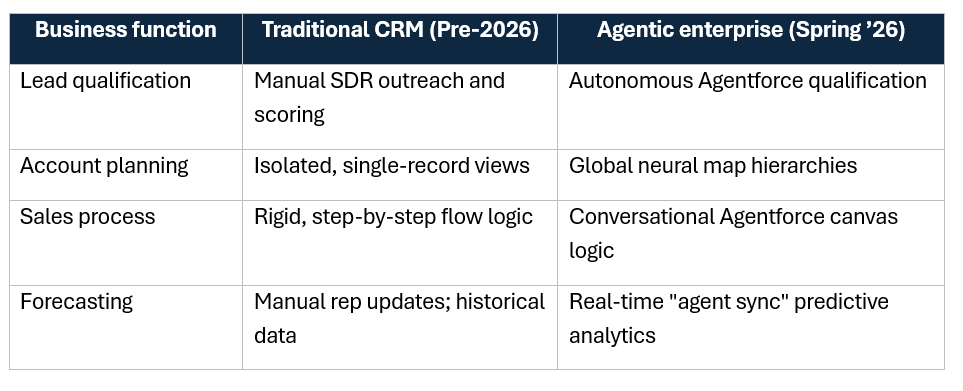
Autonomous agents now handle the repetitive sales development representative (SDR) tasks of cold outreach and qualification, executing actions instead of merely recommending them.
The shift at a glance
From people manager to outcome architect
The introduction of the Agentforce Canvas View changes the fundamental job description of a Sales Leader. Leadership is now an architectural challenge. Using the Agentforce Canvas View, leaders program their digital teammates, defining branching logic for complex objections and tuning the agent’s brand voice in a visual, conversational workspace.
Imagine launching a 20 percent New Year’s discount, but only for customers who sign a two-year contract. As an outcome architect, open the Canvas pricing topic and add a simple instruction: “Only mention the 20% promo if the customer is open to a 24-month term. Otherwise, stick to standard tiers.”
The result: Every digital agent across the company now follows that rule perfectly. It’s not managing people; it’s architecting a specific sales outcome.
Deep account intelligence: the neural map
Enterprise selling has always been challenged by data silos. With the launch of enhanced account planning in Spring ’26, Salesforce finally breaks the single record barrier.
This turns CRM into a neural map. It is now possible to track how a win in a European subsidiary influences the white space in a North American headquarters, all within a unified view. Because Data 360 (formerly known as Data Cloud) is the foundation, a sentiment change captured by an agent in one region can trigger an immediate strategic response in another. Stop looking at accounts as isolated dots and start seeing them as an interconnected system of influence.
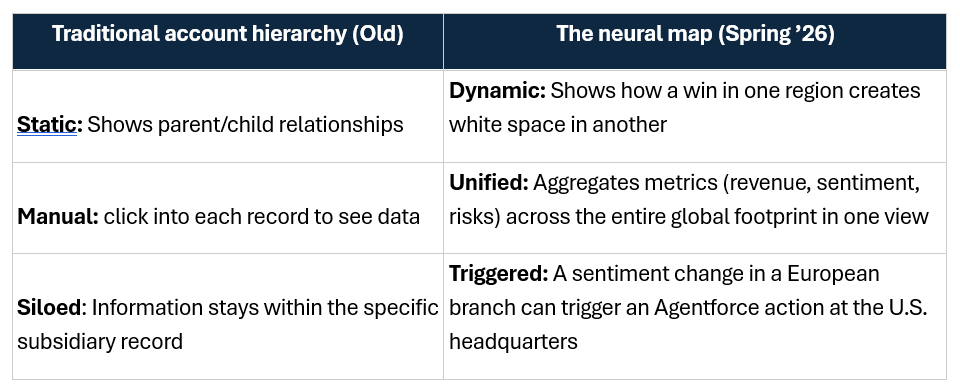
Our advisory: Since Data 360 serves as the foundational platform, a shift in sentiment identified by an agent in one territory can prompt a strategic adjustment elsewhere. Conversely, if the data foundation is disorganized, the effectiveness of the neural map is significantly diminished. We recommend clients view a Data 360 review as essential preparation for Spring ’26; it should be regarded as a prerequisite, not an option.
The evolution of the SDR: from prospector to AI operations (AOP)
The most radical shift in Spring ’26 is the restructuring of the entry-level SDR role as we know it. For a decade, the SDR role was a trial by fire — high volume, high rejection and manual outreach.
In the agentic enterprise, the SDR is evolving into the AI operations professional (AOP).
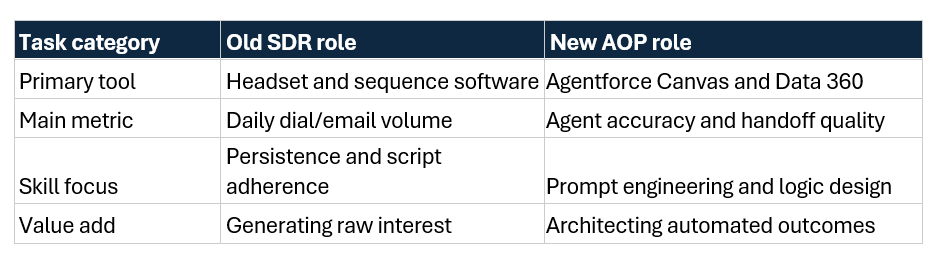
The AOP becomes the product manager of the lead funnel, ensuring the handoff between autonomous agents and human account executives is frictionless.
The new accountability: who owns the outcome?
The pivot to an agentic enterprise raises a provocative question for the C-suite: If an AI agent qualifies a lead that fails to close, who is responsible? In 2026, leaders must bridge the governance gap by auditing AI logic and ensuring that the Data 360 foundation is clean enough for agents to be truly smart.
RevOps readiness checklist

The future belongs to the architects
The Spring ’26 release marks a pivotal moment for organizations. Success now depends on how effectively human intuition is integrated with agentic execution.
- The good: administrative drudge work is gone, freeing humans for high-value closing.
- The bad: there is a significant skill gap. Retrain teams for logic design over hustle.
- The ugly: without oversight, AI will scale process errors.
To learn more about our Salesforce consulting services, contact us.