


The accelerating pace of digital innovation has driven the need for organizations to transform their marketing strategies into dynamic, data-driven powerhouses capable of shaping customer experiences and driving business success. Yet, achieving this transformation requires more than just cutting-edge technology. Rather, it demands seamless collaboration between marketing and IT teams. The good news is that, by addressing the inherent push-and-pull between these departments and establishing a strong communication framework, it is possible to overcome challenges and achieve sustainable marketing transformation.
Steps to success: A technology-enabled approach
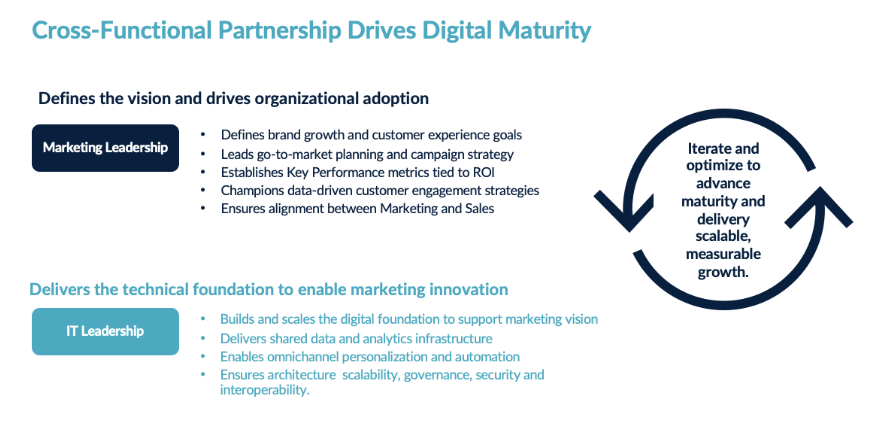
Marketing teams often prioritize agility, creativity and customer-centric initiatives, while IT departments focus on security, scalability and system stability. These differing priorities can lead to misalignment, siloed processes and delays in executing critical projects. As organizations expand, acquire new brands and diversify their digital channels, the mechanics of marketing become harder to manage. Fragmented data, inconsistent processes and siloed teams slow execution and dilute the customer experience.
Companies should focus on bridging the divides within the company before taking on any digital marketing transformation, a strategic move that supports maturity, growth and innovation while empowering teams to move faster, adapt to customer behaviors and tailor content based on shared insights. Getting there begins here:
Establish purpose and vision
Begin by aligning stakeholders around a clear mission. Whether the goal is to improve analytics, streamline content creation or scale personalization, clarity of purpose sets the tone for everything that follows. Tools like Adobe Experience Cloud can serve as the backbone of this vision, offering modular capabilities that support personalization, analytics and content management.
Build a common foundation
Conduct a MarTech ecosystem analysis to map existing use case technology to find commonality across business units. If starting with website and asset management, focus on creating common elements in a design framework, along with reusable assets and shared component infrastructure. The operational efficiencies gained allow organizations to shift spending to factors that have a greater impact, including tactical growth drivers including A/B testing, personalization at scale and more.
Align and manage data
One of the most crucial steps in the transformation involves unifying disparate data sources across the organization. IT can play a critical role in integrating customer data from web, email, mobile apps and in-store interactions into a tool like Adobe Experience Cloud, creating a single source of truth. With a strong data foundation in place, marketing can leverage advanced analytics and automation tools to design targeted campaigns and deliver personalized experiences.
Create a governance framework
Define how teams will collaborate, escalate issues and make decisions. A dedicated structure enables rapid action and minimizes misunderstandings. Governance tools embedded in platforms like Adobe help enforce standards and streamline workflows, ensuring consistency without sacrificing agility.
Onboard brands iteratively
Start small and continue to iterate, governing each iteration to maintain consistency, minimize tech debt and ensure elements in the ecosystem are maximized for use across initiatives. To continue with the website migration example, start with core components, customize where needed and migrate content efficiently. Multi-tenant architectures, such as those supported by Adobe, allow each brand to maintain its identity while benefiting from a shared infrastructure.
Personalize to improve outcomes
Leverage the shared infrastructure of the digital foundation to enable features such as custom navigation, product recommendations and geo-targeted content. Combining customer journey analytics with a personalization framework, it is possible (and easier) to achieve tailored experiences at scale to engage audiences more effectively.
AI-driven personalization is increasingly central to this effort. Platforms like Adobe and Salesforce are integrating machine learning to automate content recommendations, optimize user journeys and predict customer behavior. These capabilities allow marketing teams to deliver more relevant experiences with less manual effort.
Measure, mature and automate
Shift measurement from an afterthought to a forethought. Ensure analytics are in place to inform strategies, drive experiences and empower stakeholders to focus on results. Track progress using shared metrics. Advanced analytics capabilities, whether through Adobe or other platforms, provide visibility across business units, helping teams refine strategies and demonstrate impact. AI plays a growing role here, enabling predictive modeling, automated segmentation, and real-time optimization. As digital practices mature, AI becomes a key driver of operational efficiency and strategic insight.
Communicate and collaborate
Establishing a framework for open communication is essential. This can be accomplished by establishing a Marketing Digital Center of Excellence (CoE), which serves as a neutral ground where marketing and IT can come together to define priorities, establish governance and drive innovation. A CoE provides a platform for ongoing dialogue, ensuring teams have visibility into each other’s needs, constraints and priorities.
Facilitated workshops and joint planning sessions foster understanding between departments and enable marketing to highlight how the need for rapid execution can be balanced with IT’s focus on robust infrastructure and data security. A structured change management program guides the transformation process, emphasizing transparency and accountability.
While technology is a critical enabler in a marketing digital transformation, success ultimately depends on the ability of departments to work together toward shared objectives. Strong communication is the foundation of this collaboration, supported by leadership commitment to transparency and a robust change management program.
By fostering collaboration and leveraging Adobe Experience Cloud, organizations can turn marketing into a strategic asset that drives growth, enhances customer experiences, and delivers measurable business outcomes.
To learn more about Protiviti’s Marketing Technology Advising services or our Adobe consulting services, contact us.